Some professional events leave you with a notebook full of notes. Others leave you with new perspectives, questions, connections and ideas about what our profession could become. Global Business Analysis Day 2026 managed to do all of that.
I spent the European session, from 13:00 to 16:59, following conversations about Business Analysis, professional development, collaboration and the future of our role. And because apparently one session wasn't enough, I also joined the IIBA Tampa Chapter webinar at 1:00 a.m.: Visible, Credible, Connected: A Practical Career Playbook, presented by Chapter President Thea Soehren. Commitment level: questionable; enthusiasm: intact. 😂
Several presentations stayed with me.
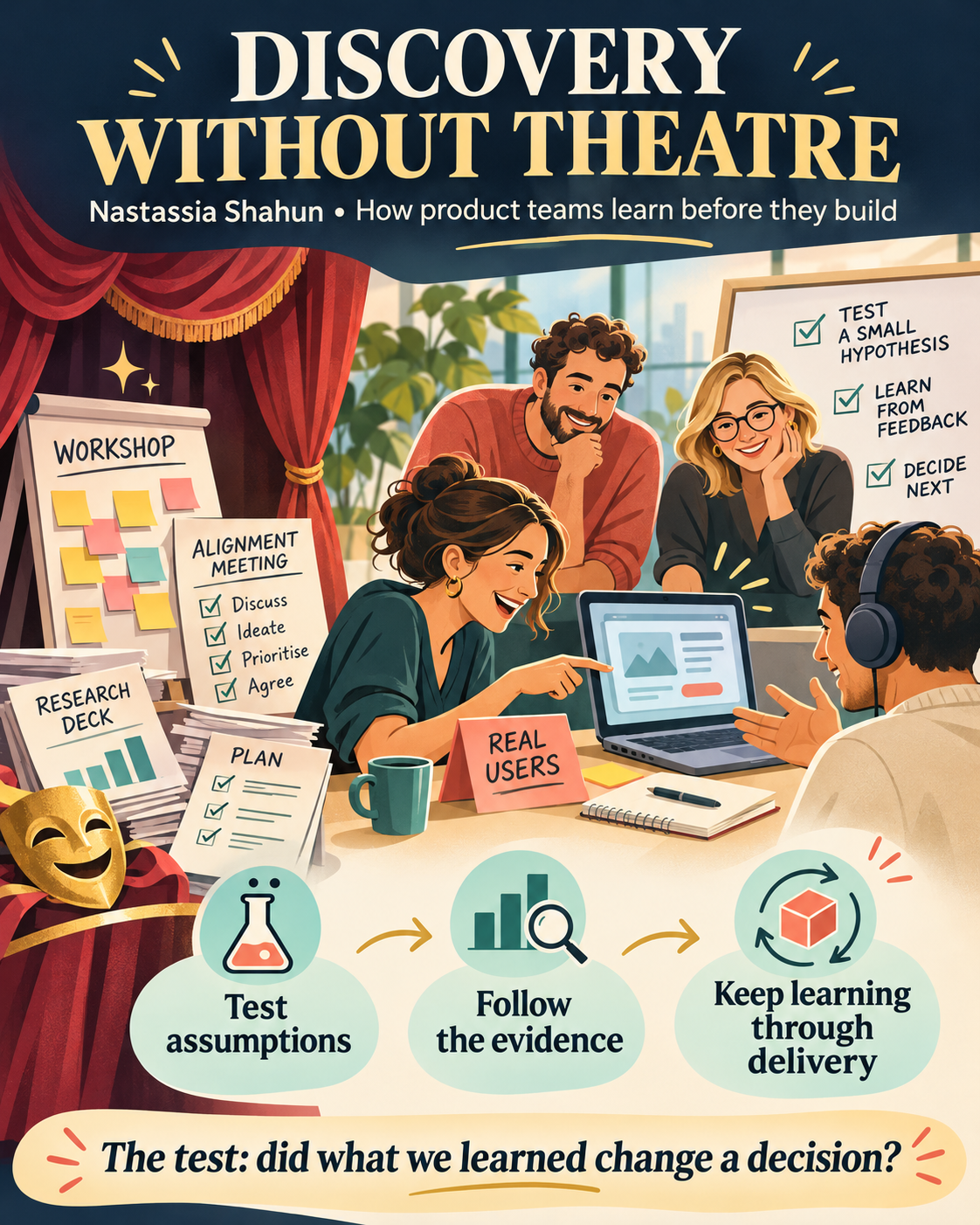
Nastassia Shahun · Discovery Without Theater
Nastassia Shahun, in Discovery Without Theater: How Product Teams Learn Before They Build, challenged the idea that workshops, stakeholder interviews and detailed documentation automatically add up to meaningful discovery.
Her distinction between discovery theatre and continuous discovery was particularly thought-provoking. The real test is whether what we learn changes a decision. Her examples of assumption mapping, hypothesis framing, discovery spikes and feedback loops reinforced a useful point: we should not only ask whether a feature shipped, but whether it solved a problem and delivered value.
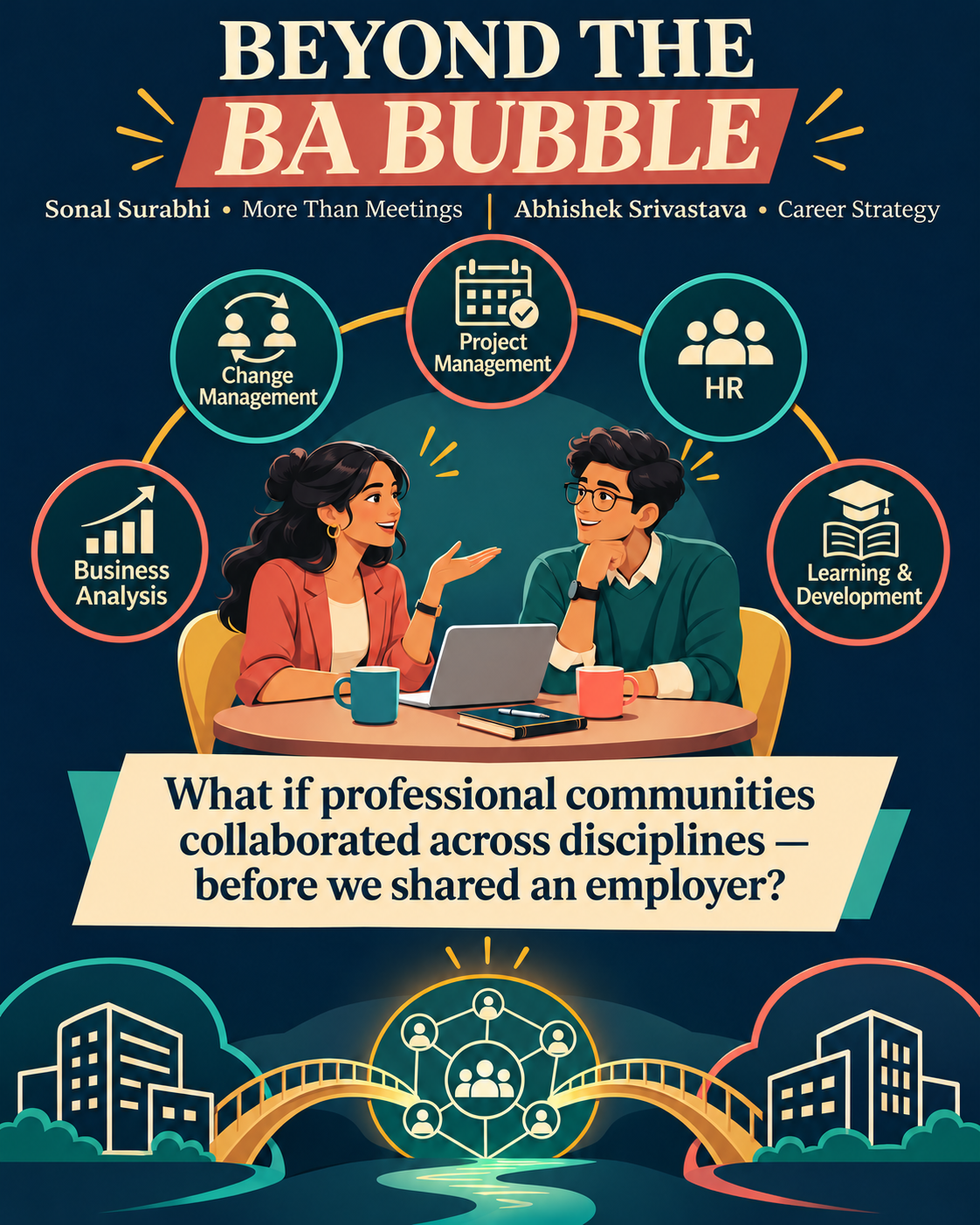
Sonal Surabhi and Abhishek Srivastava · Communities and careers
Another presentation that caught my attention was Sonal Surabhi’s More Than Meetings: Building a BA Community That Delivers Value.
Sonal described how a community can become more meaningful when members help shape the agenda, identify knowledge gaps, exchange experiences and contribute to shared learning. I liked the emphasis on moving beyond attendance to genuine engagement, and on looking at engagement, adoption and impact.
Sonal’s presentation brought me back to a conversation I’d had with my study buddy Thad Rodrigues (whom I call “The Fox” for his sharp mind and versatility) a couple of days earlier. Thad raised the idea of collaboration across professional communities and disciplines, beyond the boundaries of a single organisation. Our discussion stayed with me, and the session gave me another lens through which to think about it.
Abhishek Srivastava, speaking about career strategy and the value of bringing professionals together, also prompted me to think about the different strengths people build within the BA profession. One person may be particularly skilled in process modelling, another in requirements gathering, and another in facilitating workshops. Yet opportunities to exchange that knowledge and learn from one another are not always obvious.
It also connects with a question I would love to put to the professional community.
How might professional associations and networking communities support more deliberate cross-disciplinary collaboration beyond organisational boundaries?
Consider how Business Analysis, Change Management, Project Management, HR, and Learning & Development work together across stakeholder engagement, process modelling, requirements, organisational readiness, project delivery, and capability building. Their responsibilities often intersect, yet how often do professionals from these disciplines get to share practical experiences and learn from one another beyond their own organisations?
Imagine associate-level and early-career professionals joining working groups, peer-learning circles, mentorship partnerships and collaborative case studies across those disciplines.
Why wait until we share an employer or land on the same project before learning how our disciplines complement one another?
Could professional associations such as IIBA, Change Management, Project Management, HR, and Learning & Development communities create structured opportunities for this? Such initiatives could bridge knowledge gaps, build stronger networks, encourage mentorship and help emerging professionals become more rounded practitioners.
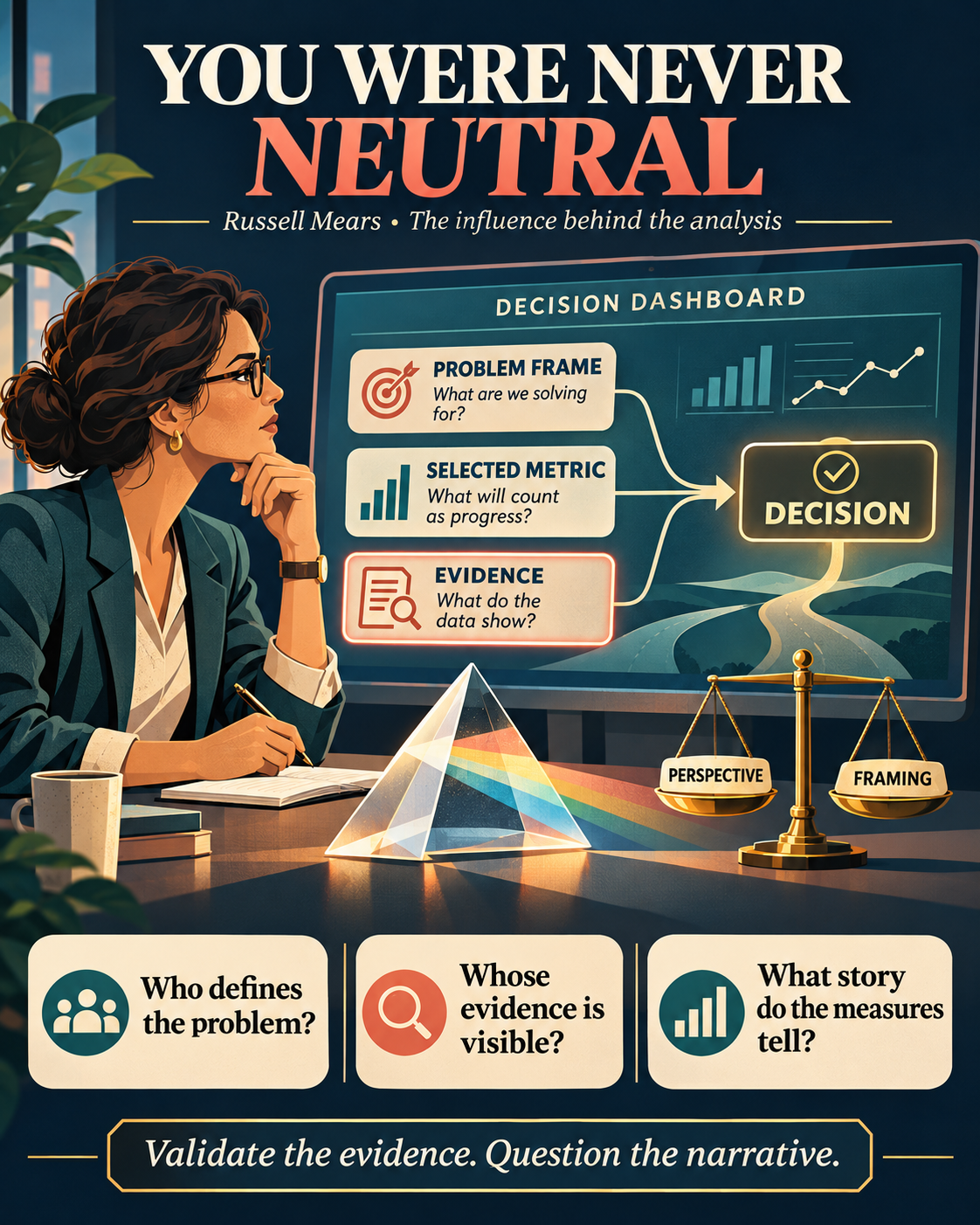
Russell Mears · You Were Never Neutral
Russell Mears, in You Were Never Neutral, offered another powerful reminder: Business Analysts do not simply describe organisational reality. The way we measure, frame problems, influence discussions and present information can shape how that reality is understood. That responsibility matters even more as AI makes polished analysis and recommendations easier to produce. We still need to question the narrative, validate the evidence and defend what is actually true.
Fabricio Laguna · From AI4BA to BA4AI
And then came Fabricio Laguna with From AI4BA to BA4AI: Empowering Business Analysts to Lead the AI Revolution. His message was a timely reminder that our role should not stop at using AI to make our work faster. Business Analysts can help organisations identify the real needs behind AI initiatives, assess risks and make sure technology delivers meaningful value.
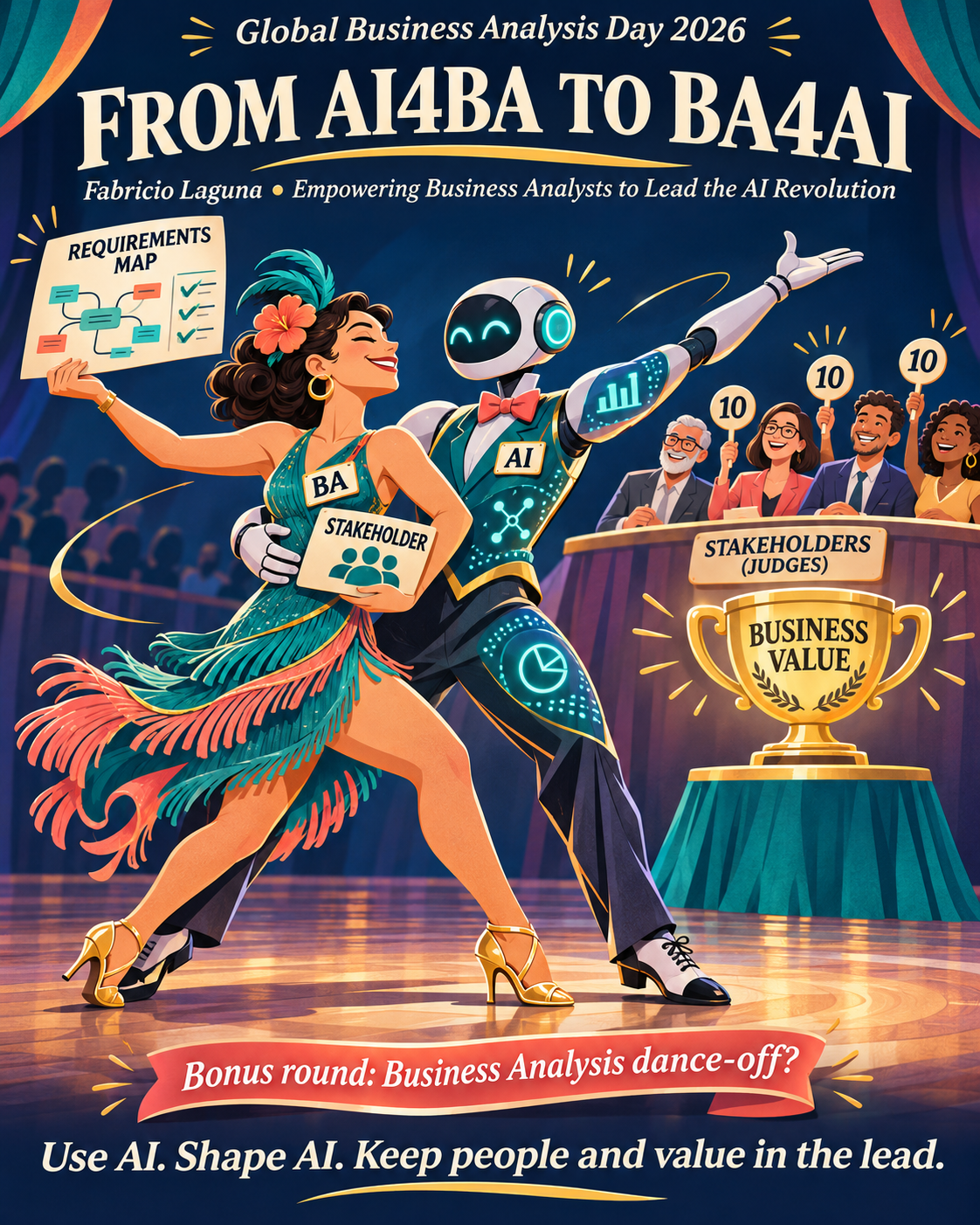
The event also reminded me that professional development should be enjoyable. The energy around Fabricio's session, the samba moments and the audience interaction brought a welcome human touch to a thought-provoking day.
Fabricio, one additional proposal: a Business Analysis dance competition. 😂💃🏽 I hope you're ready.
And to everyone who contributed to the European sessions and the Tampa Bay Chapter webinar: thank you for making the learning experience so engaging.
I came away with one thought in particular:
We talk a lot about breaking silos within organisations. Perhaps it is time to start breaking them between professional communities, too.
So, over to you:
How feasible would it be for professional associations and communities across Business Analysis, Change Management, Project Management, HR, and Learning & Development to establish structured cross-disciplinary initiatives, particularly for associate-level and early-career professionals?
What would it take to move from networking and knowledge-sharing to actually learning and working together?
And, of course, who is joining the dance competition? 💃🏽🕺🏽
Personal reflection: This article is solely my personal reflection.