When I began preparing for the Entry Certificate in Business Analysis (ECBA™), I had approximately 30 days in mind. I had started reading the BABOK Guide, and while I found the material interesting, I began questioning whether reading alone would be the most effective way for me to absorb, understand and apply the knowledge required for the examination within my intended timeframe.
My study buddy, Thad Rodrigues, introduced me to an approach he was using: creating a homemade examination simulator with an AI tool. I considered the idea and decided to adopt it as my preferred approach to ECBA preparation.
My intention was not to replace the BABOK Guide or the Business Analysis Standard. I wanted a more interactive way to consume the material, test my understanding and learn how to apply concepts to examination-style questions. I used the ECBA examination blueprint to guide the scope, with the BABOK Guide and The Business Analysis Standard as my learning resources. The blueprint identified nine examination domains: the first three drawn from The Business Analysis Standard and the remaining six from the BABOK Guide.
The nine domains and their examination weighting
The ECBA blueprint assigns a share of the exam to each domain. The first three foundational domains account for 40% of questions; the six BABOK Guide domains account for the remaining 60%.
- Understanding Business Analysis20%
- Mindset for Effective Business Analysis14%
- Implementing Business Analysis6%
- Change10%
- Need10%
- Solution10%
- Stakeholder10%
- Value10%
- Context10%
Source: IIBA ECBA Exam Blueprint V1.1. The weighting is shown as a guide to the blueprint, not as a prediction of an individual exam form.
I wanted the simulator to cover the blueprint, generate direct conceptual questions and business scenarios, use closely related multiple-choice answers, provide immediate feedback, explain every option, reference chapters and printed pages, adapt difficulty to my performance, and help me manage examination time.
Applying FLOW: how the simulator evolved
Susan K.L. Yu's presentation on judgement and decision-making introduced a useful way to look at this experience. Her FLOW framework — Frame, Learn, Iterate, Optimise and Wrap up — helped me recognise that my preparation was not simply a sequence of practice tests. It was an iterative process of identifying a need, developing a solution, evaluating its effectiveness and improving it.
1. Frame — defining what I needed to achieve
I started with a relatively simple version: 20 untimed multiple-choice questions, with the answer and an explanation provided after every response. I quickly realised that I needed more than a question bank. I wanted a simulator that could help me understand the material, identify gaps and progressively challenge me.
I defined the resources, examination scope, question format, feedback requirements and expected learning outcome. The examination blueprint became the structure for the simulator, while the BABOK Guide and Business Analysis Standard served as its reference materials. This gave the AI tool a defined purpose and boundaries instead of asking it to generate random business analysis questions.
2. Learn — discovering what the first version was missing
The first questions helped establish a routine, but I realised that answering business cases without a solid grasp of the underlying concepts could limit my ability to approach unfamiliar scenarios.
An important turning point came after the 27 October 2026 study session on BABOK Chapter 3: Confirmation, organised by the IIBA Ottawa-Outaouais Chapter. The session reinforced the importance of understanding the concepts and task-related components of the BABOK: inputs, outputs, techniques, guidelines and tools, elements, and stakeholders.
I needed to understand not only what a task was about, but why it was performed, what information it required, what it produced, which techniques could be used and who was involved. I expanded my practice beyond business cases to include direct conceptual questions and questions about task structure and related elements.
3. Iterate — improving the learning experience
This was where most of the work happened. I repeatedly tested the simulator, identified weaknesses and refined its instructions and question design. I introduced adaptive difficulty levels: a correct answer moved the next question up a level and an incorrect answer moved it down. This helped the practice sessions become more challenging in response to my answers.
Some answer options were initially too obviously different. I refined the question design so the alternatives were closely related and required more critical thinking. I wanted rigorous feedback too: why my selected option was correct or incorrect, why the other alternatives were unsuitable, and references to the relevant BABOK chapter and printed page.
There were occasions when the AI tool selected an incorrect answer. Rather than accepting it, I returned to the BABOK Guide, verified the information and referred the AI tool back to the authoritative source. I had to understand the material well enough to recognise when the tool was wrong.
I also removed task labels that appeared before questions because they could give away a clue and influence my reasoning. I wanted to identify the relevant concept independently. Over time, I introduced timed assessments as well.
| Practice stage | Format | What I was building |
|---|---|---|
| Initial review | 20 untimed questions | Understanding, pace and immediate feedback |
| Set 5 | 20 questions · 25 minutes | Blueprint and BABOK coverage |
| Set 6 | 30 questions · 35 minutes | More domains and closer answer choices |
| Set 7 | 40 questions · 40 minutes | Complex business cases and adaptive difficulty |
| Stakeholder Set 17 | 20 questions · 15 minutes | Focused stakeholder knowledge |
| Full-length Set 8 | 50 questions · 75 minutes | Blueprint-weighted examination simulation |
A visual record of the iterations
The screenshots below show how the practice evolved, from a flexible first review through progressively more demanding sets, focused stakeholder practice and a full-length timed simulation.
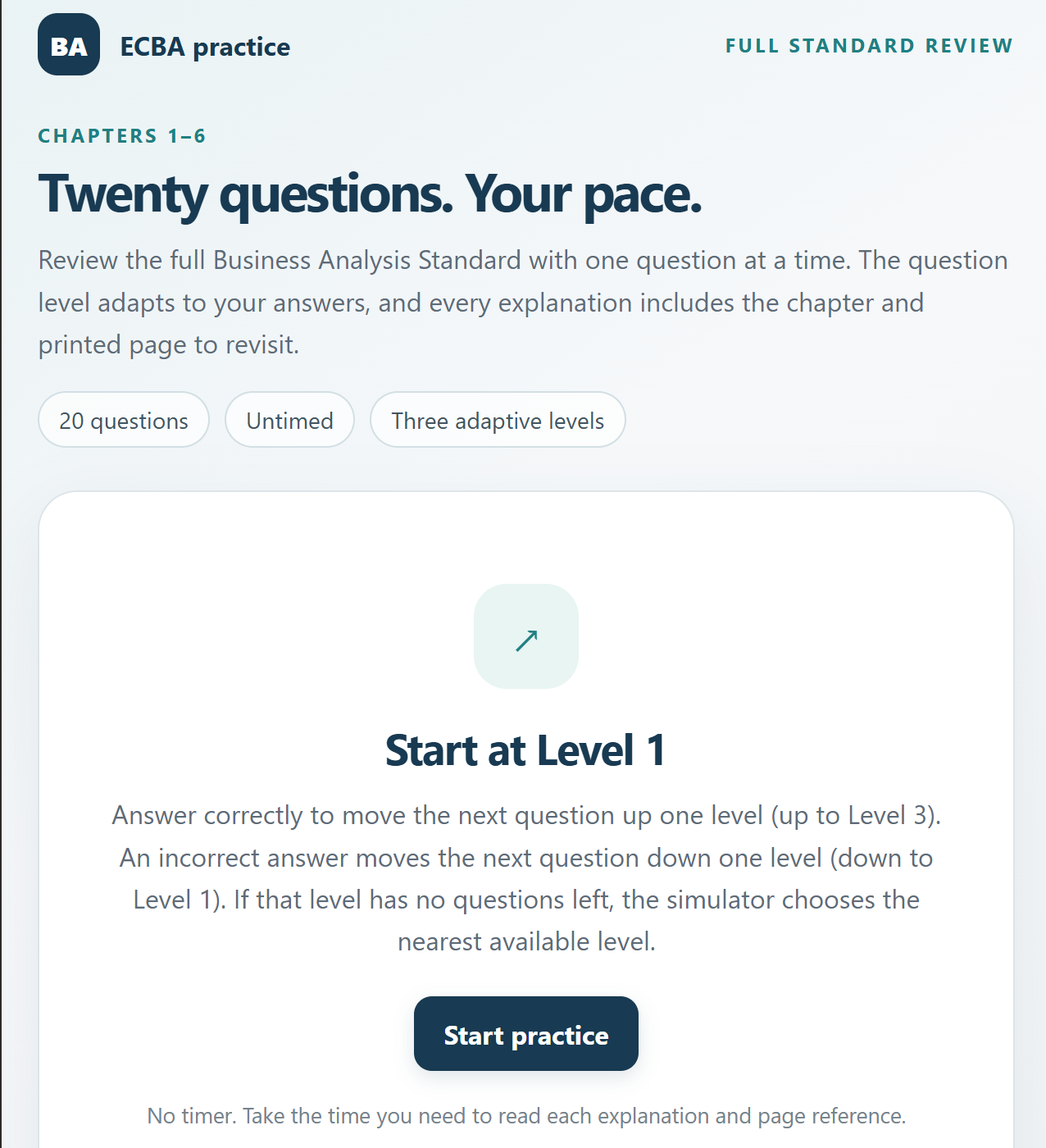
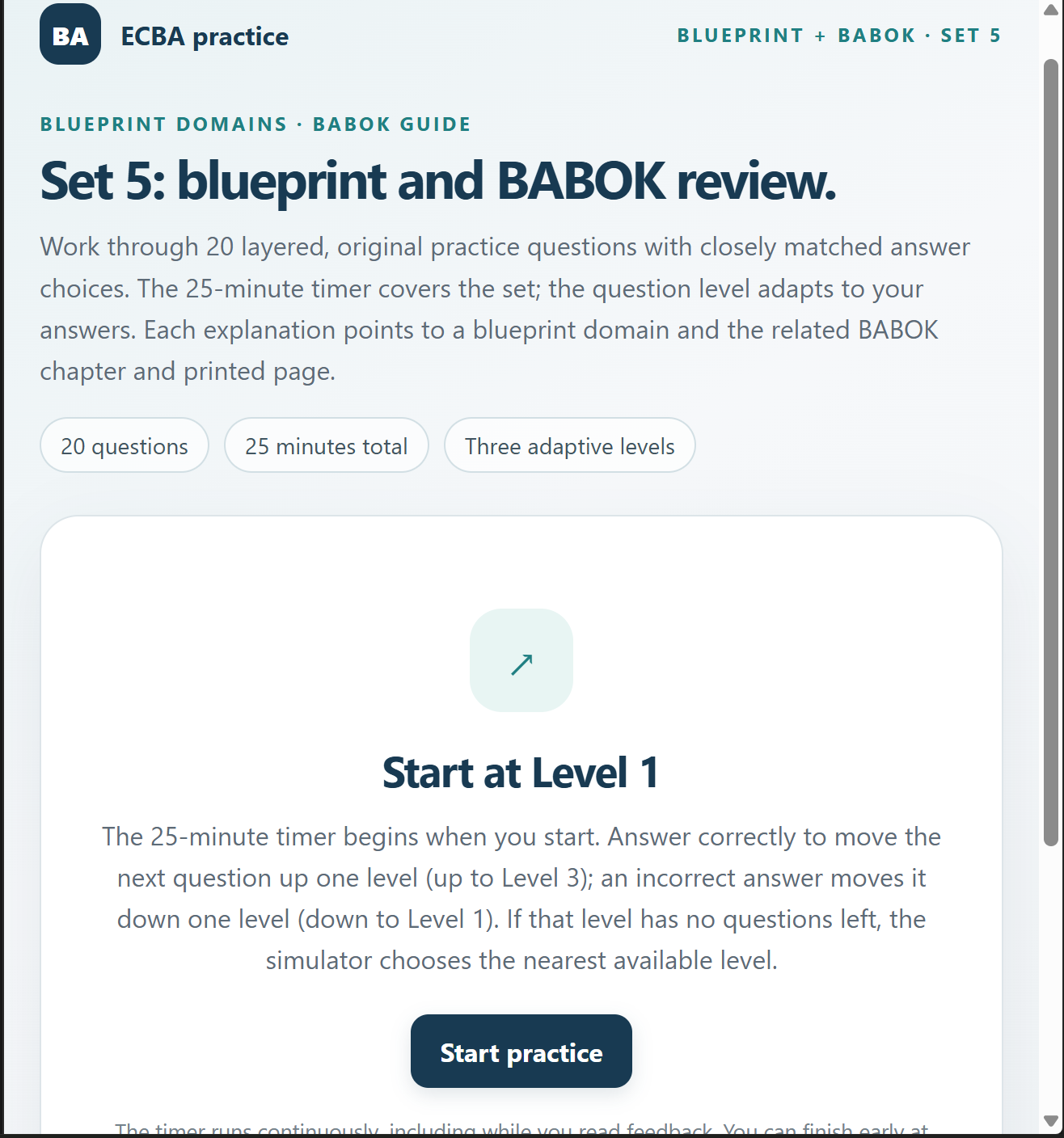
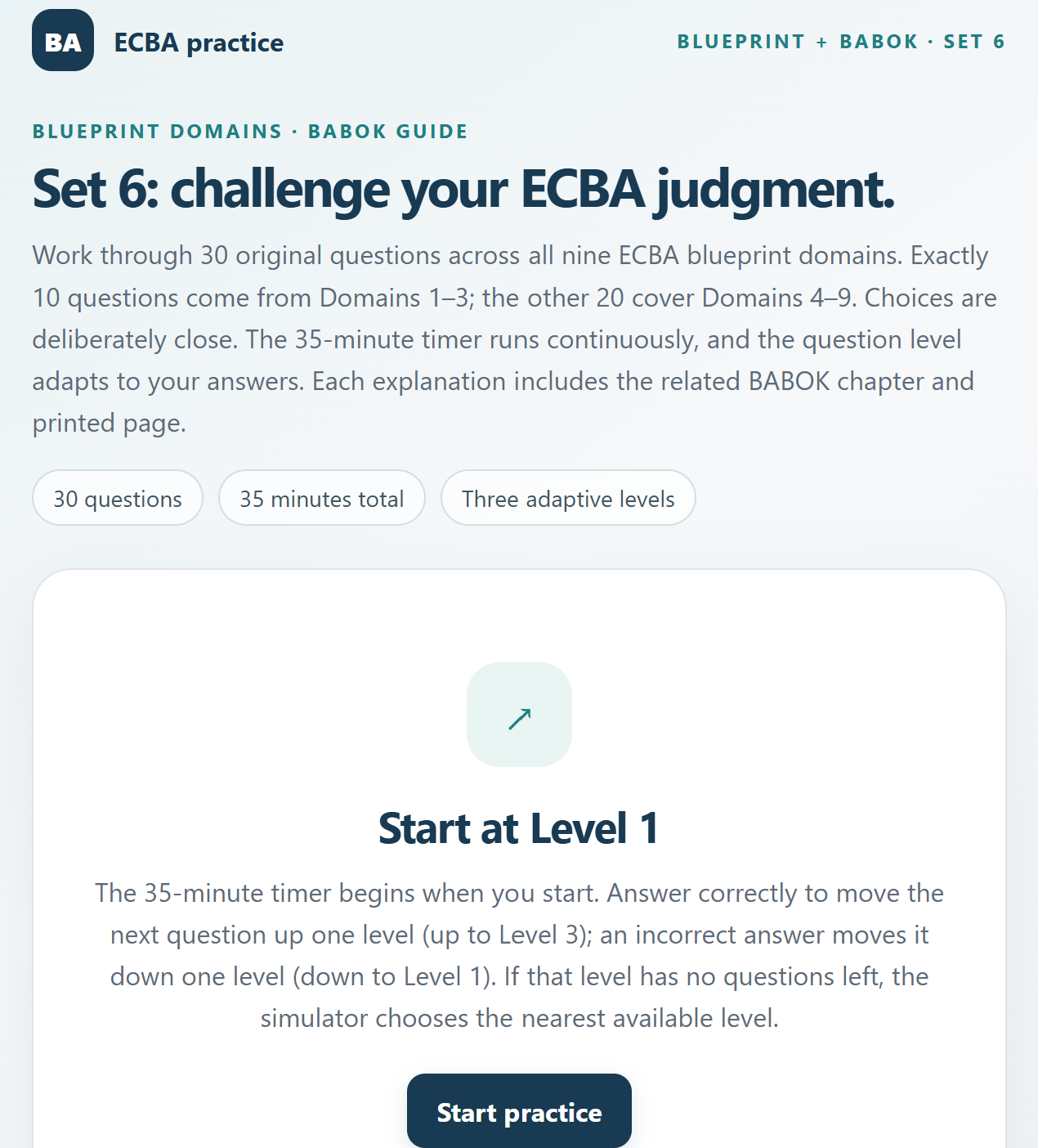
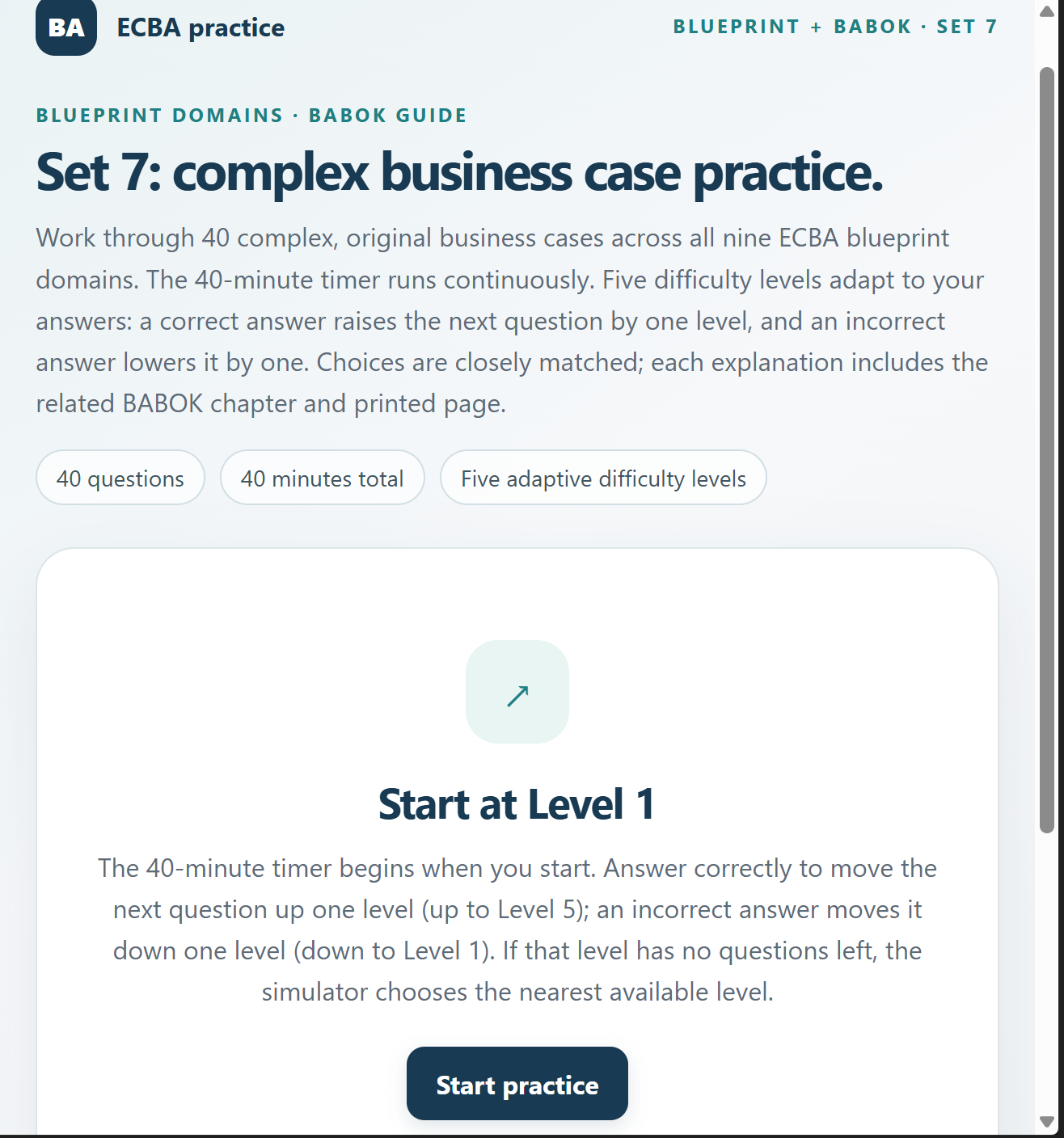
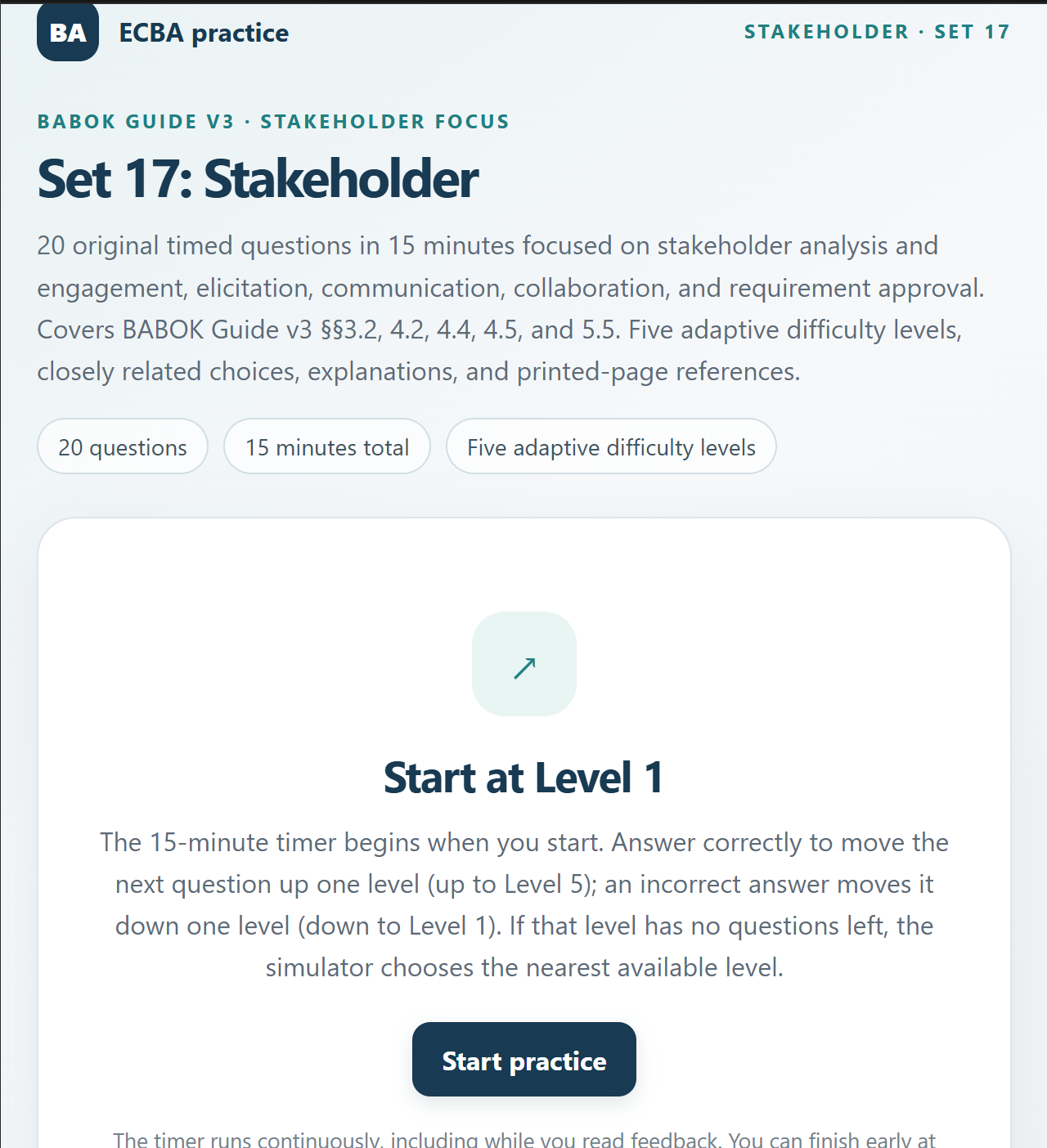
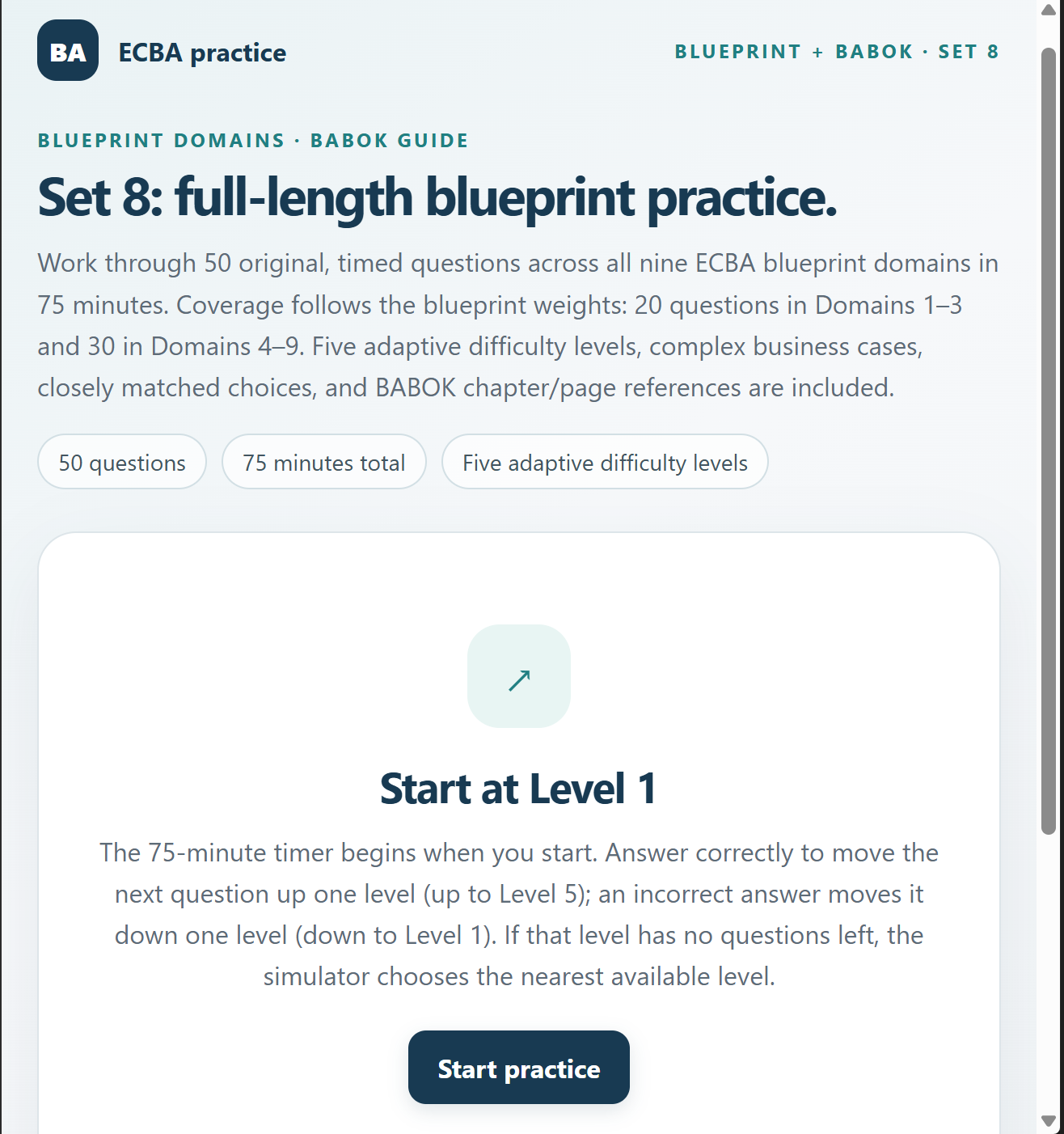
The full-length 50-question set followed the blueprint distribution: 20 questions from Domains 1–3 and 30 from Domains 4–9. Each iteration addressed a particular weakness. I was not simply asking the AI tool for more questions; I was improving the quality of the learning and assessment experience.
4. Optimise — applying the four disciplines of judgement
Susan K.L. Yu's four disciplines — Clarity, Evidence, Perspective and Value — provide another lens through which I can examine the decisions I made.
Clarity: was I solving the right problem?
My problem was not simply that I needed more questions. I needed to understand ECBA knowledge areas and apply that knowledge to different situations within a limited preparation period. I clarified the examination scope using the blueprint, selected authoritative resources, defined the question formats and feedback, and removed task labels that could give away clues.
My judgement question: Was the simulator genuinely testing my understanding, or was it making the questions easier by giving away clues?
Evidence: why should I trust the answers?
The AI tool could generate questions and explanations, but I discovered that some selected answers were incorrect. I learned to distinguish an answer that sounds convincing from one supported by the source material. My response was to return to the source for verification and refer the AI tool back to the authoritative material. I added chapter and printed-page references so I could trace explanations to the original resources.
My first non-proctored practice examination score was 84%; my second was 100%. These results encouraged me, but I did not treat them as a substitute for understanding. My ability to challenge incorrect AI-generated answers depended on the knowledge I had developed.
My judgement question: What evidence supports this answer, and have I verified it against the authoritative source?
Perspective: whose needs and viewpoints have I considered?
Although this was an individual learning project, my approach benefited from different perspectives. Thad Rodrigues introduced the homemade simulator approach that I adopted. The ECBA examination blueprint provided the examination perspective. The IIBA Ottawa-Outaouais Chapter's study session on BABOK Chapter 3: Confirmation added valuable learning context. The BABOK Guide and Business Analysis Standard provided the authoritative knowledge base against which I evaluated AI-generated content.
I also considered my own perspective as the learner: my objectives, preparation timeframe and areas needing improvement. However, I should not assume that an approach that worked for me will work equally well for every ECBA candidate. Different learners may need different combinations of reading, practice questions, group discussions and practical application.
My judgement question: Have I mistaken my own needs for everyone's needs?
Value: did the solution deliver the outcome that mattered?
The value of the simulator was not simply that I had created a tool capable of generating examination questions. Its value was in helping me develop conceptual understanding, practise applying knowledge, identify weaknesses, receive immediate feedback and become more confident in managing examination time.
I took the actual ECBA examination after 17 days of using the simulator and passed. My 50-question simulator sessions were timed for 75 minutes, matching the examination duration, and I consistently finished early. On the actual examination, I finished with 15 minutes remaining, which I used to revisit questions I had flagged.
My judgement question: Did the solution deliver the outcome that mattered, or did I simply produce an impressive learning tool?
5. Wrap up — what I learned and will carry forward
| Area | My reflection |
|---|---|
| Initial need | Prepare effectively for the ECBA within a limited timeframe. |
| Decision | Adopt an AI-powered homemade simulator approach suggested by my study buddy, Thad Rodrigues. |
| Rationale | Create an interactive, adaptive and examination-focused learning experience. |
| Key assumption | AI-generated questions and explanations could be aligned with official learning resources. |
| Main risks | Incorrect answers, weak distractors, misleading explanations and false confidence. |
| Mitigation | Verify answers against the BABOK Guide, refer the AI tool back to the source, refine the design and test independently. |
| Evidence of progress | 84% in my first non-proctored practice examination and 100% in my second. |
| Outcome | I passed the ECBA after 17 days of using the simulator. |
| Additional benefit | I had 15 minutes remaining in the actual examination to revisit flagged questions. |
The most important lesson for me was that the simulator could not replace my understanding of the material. In fact, the occasions when it produced incorrect answers made my conceptual knowledge even more important. I had to challenge the tool, verify its output and decide whether the explanation deserved to be trusted.
Beyond the simulator: the Business Analyst's judgement
This experience made me appreciate that Business Analysis is not limited to producing documents, models, reports or solutions. It involves understanding the problem, defining what needs to be achieved, evaluating evidence, considering different perspectives and ensuring that the chosen solution delivers value.
I began with an examination preparation challenge and adopted an approach suggested by my study buddy. Through structured framing, learning, iteration and optimisation, I developed a learning solution that supported my goal. I did not simply use AI to generate questions. I used it as part of a process that required my own judgement, verification and accountability.
Sometimes the best way to understand a framework is to recognise that I have already been applying its principles in my own decisions.
Acknowledgements
I am grateful to Thad Rodrigues, my study buddy, for introducing me to the homemade AI-powered simulator approach that I adopted for my ECBA preparation.
I also acknowledge Susan K.L. Yu for her presentation on judgement and decision-making, which encouraged me to reflect on this experience through the FLOW framework and the four disciplines of Clarity, Evidence, Perspective and Value.
I appreciate the learning opportunity provided by the IIBA Ottawa-Outaouais Chapter, particularly its 27 October 2026 study session on BABOK Chapter 3: Confirmation.